'Tis the great birth-right of mankind to die."
James Thomson (1700-1748)
"All history is biased by accidents of documentation."
Arthur Wagner, 1923
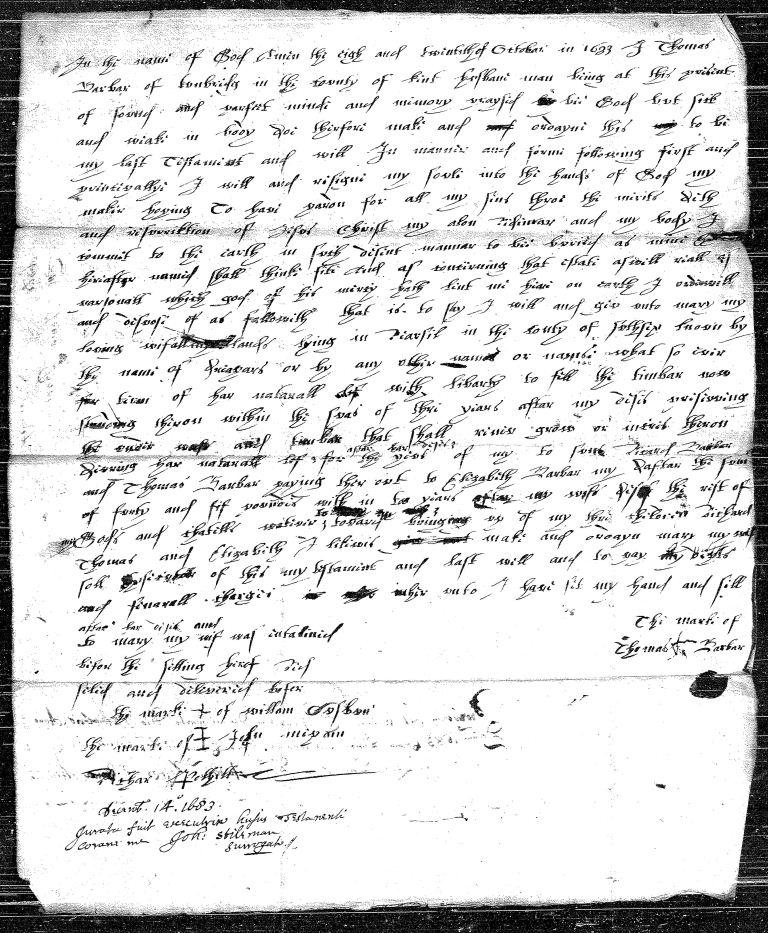
Wills provide a fascinating insight into the past and are probably the most reliable source for identifying family members and kin (surviving members at least). They usually reveal the testator's occupation, wealth and property, giving insights into lifestyle and status. They are also one of the few official documents that can convey personal feelings and thoughts.
See the "Other Indexes" tab for indexes of those who left wills.
Sometimes a will is the only proof of a link to that family, as baptism records may have been lost or simply not entered into the parish register, a not uncommon occurrence in the 16th and 17th centuries. Wills are also important in identifying the married names of daughters. The further back you go, the more important they become for your research.
It is important to understand the difference between a will and an administration (often referred to as an "admon"). A person who dies without a will is said to have died intestate, and in this case a person, usually a spouse or other family member, will be granted "Letters of Administration" which gives them the right to administer the deceased's estate according to the laws of intestacy. Where there is a will, it must be presented to a probate court to be validated (giving time for objections to be heard), and when all is satisfactory an act of probate is issued, which enables the executor(s) to administer the estate according to the wishes of the testator as expressed in the will.
When searching for wills on websites such as Ancestry or Familysearch, it is useful to understand that there can be two copies of that same will - an original signed by the testator and a copy written out by the probate court. Often the copy is written more clearly and can be useful if you have difficulties in transcribing the original. The use of AI in transcribing handwitten wills is now a great boon to family historians, although the results must be checked manually as there are often mistakes due to poor handwriting.
Before 1858, Acts of Probate and grants of Letters of Administration were performed by the Church of England probate courts, and there were over 200 of them. At a national level, there was the Prerogative Court of Canterbury and the Prerogative Court of York, covering the south and north of England respectively. At the local level there was the Bishop (Diocese) Courts, the Archdeaconry Courts and the Peculiar Courts. Your ancestor could have a will proved in a national level court, or a local court (usually depending on the size of the estate and whether there was property in more than one diocese), but not both.
So for Sussex, wills were proved either in the Prerogative Court of Canterbury or in one of the following [local] probate courts:
The [Local] Church Probate Courts for Sussex
(Source: https://www.familysearch.org/en/wiki/Sussex_Probate_Records)
The county of Sussex forms the Diocese of Chichester which comprises six local Probate Courts:
1. Archdeaconry of Lewes Consistory Court (all East Sussex except for the Peculiars below))
2. Archdeaconry of Chichester Consistory Court (all West Sussex except for the Peculiars below)
and Four (4) Peculiar Courts:
3. Court of the Peculiar of the Dean of Chichester
Parishes of Chichester St Andrew, Chichester St Bartholomew, Chichester St Martin, Chichester St Olave, Chichester St Peter the Great, Chichester St Peter the Less, Chichester St Pancras, New Fishbourne, Rumboldswyke
4. Court of the Peculiar of the Archbishop of Canterbury for the Exempt Deaneries of Pagham and Tarring
Held concurrent jurisdiction over the parishes of Chichester All Saints, Horsham (part), East Lavant, Pagham, Patching, Slindon, South Bersted, Tangmere, West Tarring inluding Durrington & Heen
5. Court of the Peculiar of the Archbishop of Canterbury for the Exempt Deanery of South Malling
Parishes of Buxted, The Cliffe or St. Thomas Lewes, Edburton, Framfield, Glynde, Isfield, Lindfield, Mayfield, Ringmer, South Malling, Stanmer, Uckfield and Wadhurst
6. Court of the Peculiar of the Exempt Jurisdiction of the Deanery of Battle
Parish of Battle
All these are now available on Ancestry so it is not so important to know which probate court your ancestors used. For more information on these courts see https://www.familysearch.org/en/wiki/England_Overview_of_Church_Courts_-_International_Institute
On 12 January 1858, a secular National Court of Probate was established replacing the church courts. It established a single National Probate Calendar (a national index) but with 40 District Registries. Copies of post 1858 wills can be obtained at https://www.gov.uk/search-will-probate
Only 10% of the people who died in 1858 had a will proved or an administration granted